

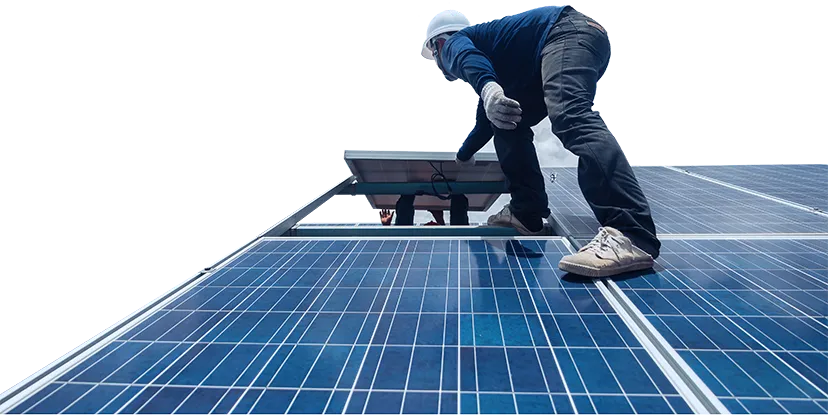
Solar Earthing Kit & Lightning Arrester
Kamaxi Electricals supplies complete earthing and lightning protection for solar plants: maintenance-free earthing electrodes, backfill compound, earth pit covers, earthing cable and ESE / conventional lightning arresters. A proper earthing system gives fault current a safe path to ground and protects people, panels and inverters from lightning surges.
Earthing kit calculator
Separate earth pits are kept for the DC side (module frames and structure), the AC side (inverter and ACDB) and each lightning arrester, as is common practice for rooftop plants. Measure earth resistance after installation as per IS 3043.
ESE lightning arrester: protection radius & quantity
Protection radius Rp (m) for this ESE
As per NF C 17-102:2011: for h ≥ 5 m, Rp = √(2Dh − h² + ΔL(2D + ΔL)) with ΔL = ΔT (µs) in metres; for 2 m ≤ h < 5 m, Rp = h × Rp(5) / 5. Quantity assumes a square grid of arresters so the protection circles overlap the whole area.
Kit components
| Component | Typical specification |
|---|---|
| GI earthing electrode (pipe-in-strip) | 1 / 2 / 3 m, outer pipe 48-88 mm, inner strip 25×3 mm, terminal 40×6 or 50×6 mm, hot-dip galvanized |
| Copper-bonded earthing rod | 14.2 / 17.2 mm dia, 250 micron copper bonding, 1.2 to 3 m |
| Backfill compound | Low-resistivity, non-corrosive, bags of 5 / 15 / 25 kg |
| Earth pit cover | Polymer or cast iron, about 254 mm top / 330 mm bottom / 260 mm high |
| Earthing cable / strip | Cu 6-16 sq mm (green / yellow-green) or GI strip 25×3 mm |
| Lightning arrester | ESE with ΔT 25 / 40 / 60 µs or conventional spike rod, GI mast with down conductor |
How many earth pits does a rooftop solar plant need?
Common practice is separate pits for the DC side (module frames and structure), the AC side (inverter and ACDB) and each lightning arrester, so a typical rooftop plant has three pits. Larger plants need more.
What earth resistance should I aim for?
Measure after installation and follow IS 3043 and your DISCOM or CEIG requirement. Lower resistance is better; backfill compound and the right electrode length help reach the target in dry soil.
How is the ESE lightning arrester radius calculated?
As per NF C 17-102, the protection radius depends on the protection level, the early streamer emission time and the height of the tip above the area. The calculator above uses the standard formula and works out how many arresters cover your roof.
GI or copper-bonded electrode?
GI pipe-in-strip electrodes with chemical backfill are cost-effective for most soils. Copper-bonded rods last longer in corrosive or very moist soil.
Do you supply the complete kit?
Yes. We supply electrodes, backfill compound, pit covers, earthing cable and lightning arresters with masts as one kit for your plant size.
